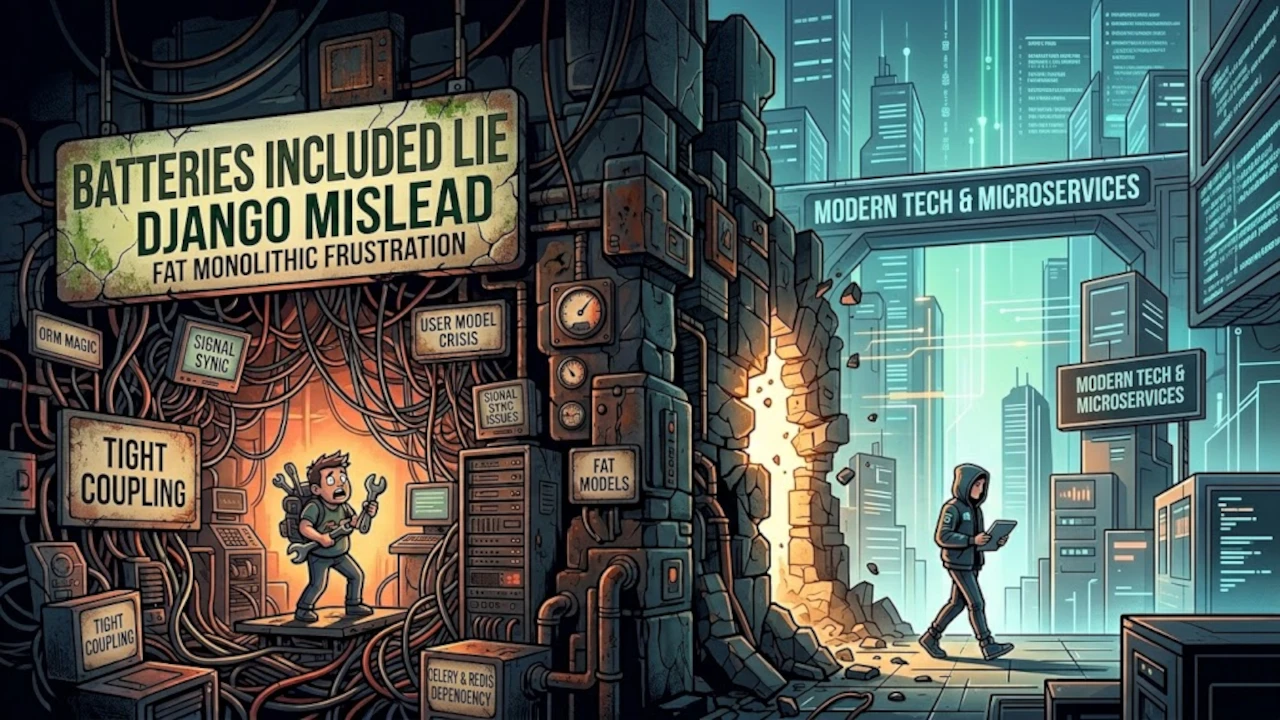
In web development, Django is marketed as the ultimate “batteries included” framework — a complete solution that promises to handle everything so you can focus on building. I decided to test that claim. I built a simple personal blog with it. That single project was my only real experience. It taught me that the “batteries included” story is largely a lie. What I found instead was a system built on excessive magic, hidden behaviors, and constant need for extra tools just to make basic things work. After finishing that blog, I walked away and never wanted to use Django again.
The framework presents itself as beginner-friendly and comprehensive, yet every step revealed deeper friction. Features that should feel helpful quickly became sources of confusion and technical debt. Here is exactly why one project was more than enough.
1. Too Much "Magic," Not Enough Clarity
From the very first day, Django’s love for magic became exhausting. The ORM does so much behind the scenes that it’s often impossible to tell what code will actually execute. Signals were the worst offender. I set up a simple post-save signal for notifications, and suddenly unrelated parts of the application started behaving in unexpected ways.
Debugging required hunting through files, settings, and third-party packages just to understand the flow. In a small blog with fewer than ten models, I already felt lost. Actions in one corner silently triggered effects elsewhere. There was no clear, linear path to follow. Everything felt implicit and mysterious rather than explicit and obvious. This constant hidden behavior made the codebase stressful to work with, even for a solo project. What was sold as productivity turned into constant surprise and wasted time tracing invisible connections.
2. The Rigid User Model and Tight Coupling
Django’s User model is famously inflexible. I needed basic custom fields from the start. Setting it up correctly required careful planning before the first migration, otherwise painful refactoring awaited. In my blog I had to extend it early, yet small changes later still caused cascading issues across models, forms, views, and admin panels.
Everything in Django is tightly coupled. Models know about forms, views reference models directly, and the admin depends on all of it. Changing one piece risked breaking others in surprising ways. Even minor adjustments to authentication or profile data created widespread ripple effects. The framework’s design assumes you get the architecture perfect upfront. For any real-world evolution, the coupling becomes a straightjacket that makes maintenance feel dangerous rather than safe.
3. The Lack of Type Safety
Working with Django’s ORM after using type-safe environments felt like stepping back in time. Queries rely on string-based lookups like user__profile__settings__theme. There is no compiler to catch typos, wrong field names, or outdated relationships. Every mistake only appears at runtime, often in production-like testing.
During blog development I spent hours chasing subtle query bugs that a proper type system would have flagged instantly. Schema changes required manual verification everywhere. The absence of build-time safety turned simple operations into sources of anxiety. What should have been confident coding became cautious guesswork and repeated runtime debugging.
4. Performance and Memory Overhead
Even for a low-traffic personal blog, Django’s resource demands were surprisingly high. The entire monolithic framework loads into memory for every worker process. Adding basic features quickly increased RAM usage. Running the application locally or in containers felt heavy and inefficient.
Startup times were noticeably slow. Each code change meant waiting for the development server to reload large parts of the framework. For a framework that claims to be productive, the constant overhead of its own size became a daily annoyance. Scaling even modest traffic would require multiple processes, making deployment feel bloated and expensive in resources.
5. The Constant Infrastructure Tax
One of the biggest lies of “batteries included” is that you still end up needing many external tools for basic functionality. I wanted simple background email sending when a new comment arrived. Django offered no clean built-in solution. I had to bring in Celery, a message broker like Redis, separate worker processes, monitoring, and extra configuration.
What should have been a small feature ballooned into managing an entire additional ecosystem. Caching, async tasks, periodic jobs — almost every non-trivial need required yet another library, another service, another layer of complexity. The framework includes a lot, but the pieces that truly matter in real applications often demand external additions that add maintenance burden and operational complexity.
6. Fat Models and Logic Sprawl
Django encourages putting business logic directly into models. In my blog, what started as simple Post and Comment models quickly grew fat with methods, properties, and custom managers. Database concerns mixed with application rules in the same files.
This created messy, hard-to-test code. Unit testing became awkward because models were tightly bound to the database. As features grew, logic scattered across models, views, signals, and template tags. There was no clean separation. The “fat models” approach that many praise turned into logic sprawl that made the small project harder to understand and modify than it should have been.
7. Fragile Migrations
The migration system, often advertised as a strength, proved fragile even in solo work. Small schema changes across feature branches created conflicting migration files. Merging them frequently led to inconsistent database states that required manual fixes and careful squashing.
What should have been a simple version control story for the database became a recurring source of frustration. I lost hours resolving migration conflicts that added no value to the actual blog features. The system works fine when everything goes perfectly, but real development with branches and iterations exposes its brittleness.
8. Weak CI/CD Safety and Runtime-Only Failures
Django offers no compile-time error catching. This forces CI/CD pipelines to rely almost entirely on tests. If test coverage is not close to 100%, builds pass cleanly even when bugs exist. Problems only appear at runtime — often after the code is already in production. Small typos in queries, missing fields, or wrong signal logic slip through the pipeline and break in live environments. The lack of build-time safety makes continuous deployment riskier and puts heavy pressure on writing perfect tests for every possible runtime scenario.
More Reasons the Experience Fell Short
Beyond the main issues, other aspects reinforced my disappointment. Building even a basic JSON API felt heavier than necessary. The built-in template engine, while functional, mixed presentation logic in ways that created maintenance headaches. Development velocity slowed as the project grew because of long reload times and framework overhead. The monolithic structure made the application feel like one giant intertwined system rather than clean, focused pieces. Async support existed but still felt secondary and incomplete compared to the framework’s overall synchronous roots.
Everyday tasks required fighting the framework’s opinions or adding yet more packages. Authentication, file handling, admin customization, validation — each area that should feel complete instead demanded workarounds or extensions. The promise of everything being included turned out to mean many things are half-solved, pushing developers toward external solutions anyway.
After completing that one blog project, I reflected on the experience. What I wanted was clarity, control, and predictability. Instead, Django delivered hidden behaviors, tight coupling, runtime surprises, and constant extra tooling. The “batteries included” marketing creates expectations that the framework cannot fully meet without significant friction.
I tried Django once. I built a working blog. I learned its patterns and its limitations firsthand. That single project was sufficient to show me that its philosophy does not align with how I prefer to work. The magic that helps beginners move fast becomes technical debt. The included batteries require frequent replacements with third-party solutions. The convenience comes at the cost of transparency and long-term maintainability.
Django may suit certain large teams or specific CRUD-heavy applications where its conventions provide structure. For me, after one real project, the drawbacks far outweighed the benefits. I finished the blog, deployed it, and moved on — wiser about what I don’t want in a web framework.
The batteries included lie is simple: you still end up managing a complex web of magic, dependencies, and workarounds. One project was enough to see through it.